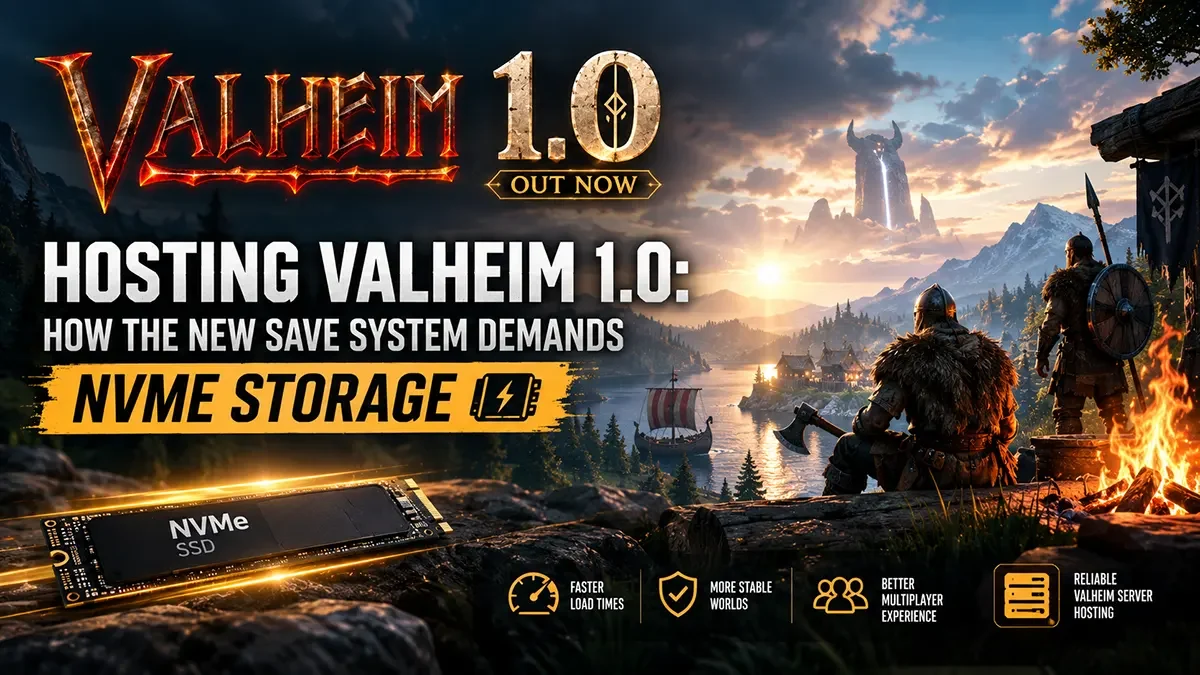
After five years of Early Access, Valheim 1.0 has officially launched. The “Deep North” update brings a massive amount of content to the Tenth World, including rideable moose, grappling hook traversal, and the sprawling, icy Deep North biome.
But for server admins, the most critical changes aren’t the new Frost Foundry or the 80+ build pieces. The real game-changer is happening entirely under the hood: Iron Gate has completely overhauled the world save system and opened the floodgates with full crossplay for PC, PS5, and Nintendo Switch 2.
If you are spinning up a dedicated server for the 1.0 launch, your infrastructure is about to be tested. Here is the hardware reality check on Valheim‘s new chunk-based save system and why legacy storage will absolutely crush your server performance.
The Legacy Problem: The “World Save” Freeze
If you hosted a Valheim server during Early Access, you are intimately familiar with the dreaded world save stutter.
Historically, Valheim managed its world data using a massive, monolithic .db file. Every 20 to 30 minutes, the server would pause everything to write this massive file to the disk. As your players explored more of the map and built larger bases, this file size ballooned. Eventually, those routine autosaves resulted in agonizing three-to-five-second hard freezes where players would rubberband, ships would take phantom damage, and combat would become a gamble.
The 1.0 Solution: Chunk-Based Saving
To solve this for the 1.0 release, the developers refactored how the engine handles world data. Instead of dumping a single, massive file every 20 minutes, Valheim 1.0 now utilizes a chunk-based save system.
World data is split into smaller, localized segments. When a save triggers, the server only needs to rapidly write the data for the specific chunks that have been modified, rather than overwriting the entire world state. On paper, this drastically reduces the duration of the save freeze.
The Hardware Reality: Why IOPS Matter More Than Ever
While the new chunk-based system fixes the long pauses, it fundamentally changes how the server interacts with your storage drive. Instead of one large, sequential write, the server now executes thousands of tiny, rapid read/write operations (IOPS) simultaneously.
If your server is running on older mechanical hard drives or even standard SATA solid-state drives (SSDs), you are operating on borrowed time. In today’s gaming landscape, enterprise NVMe storage is no longer an upgrade, it is the bare minimum requirement. Anything slower than NVMe is practically unacceptable for modern titles and will directly degrade performance.
Without those blistering read/write speeds, you create a massive ‘I/O bottleneck.’ Your CPU might be fast enough to calculate the terrain or process entity physics, but it is forced to completely freeze and wait for an outdated storage drive to finish processing the files. This storage lag is the hidden culprit behind those frustrating ‘micro-stutters’ during rapid map exploration and the hard, multi-second freezes that occur during routine world autosaves.
Grappling Hooks and Single-Thread Bottlenecks
Storage isn’t the only bottleneck you need to watch out for in 1.0.
The Deep North introduces highly vertical terrain, grappling hooks, and complex new AI logic for the Jotun faction. As players fling themselves across chasms and generate new terrain at high speeds, the server’s single-core processing speed is heavily taxed. If you are hosting your 1.0 world on a budget “shared thread” vCPU plan, your server is going to choke the moment your players start exploring the new biome.
Host Valheim 1.0 on Extreme-Frequency Hardware
With the influx of console crossplay players and the demanding new chunk-based save system, Valheim 1.0 is not a game you can reliably host on a budget $10/month node.
At East Gate Hosting, we engineer our infrastructure specifically for these high-I/O workloads. We deploy exclusively on pure Enterprise NVMe storage, delivering the astronomical IOPS required to instantly process Valheim’s new save system without dropping server ticks. Paired with our unthrottled, extreme-frequency CPUs, your community can build massive fortresses and explore the Deep North without a single micro-stutter.
Our custom Pterodactyl panel is fully crossplay-ready right out of the box, allowing you to seamlessly connect your PC, PS5, and Switch 2 communities in seconds.
Quick FAQ: Valheim 1.0 Dedicated Servers
Does Valheim 1.0 have crossplay? Yes. The 1.0 launch includes full crossplay support across PC (Steam/Game Pass), Xbox, PS5, and Nintendo Switch 2. Dedicated servers must have the -crossplay parameter enabled in their startup flags. Read more about this in our Valheim Crossplay Setup Guide.
Why does my Valheim server freeze every 20 minutes? By default, Valheim triggers a world save every 20 to 30 minutes. If your server is hosted on a slow SSD or mechanical hard drive, the server must pause the game loop to finish writing the data, resulting in a noticeable freeze for all players.
What hardware is best for a Valheim 1.0 server? To avoid world-save lag and terrain generation rubberbanding, Valheim requires a CPU with extremely high single-core clock speeds and pure NVMe storage to handle the high IOPS demands of the chunk-based save system.